 Image 1 of 3
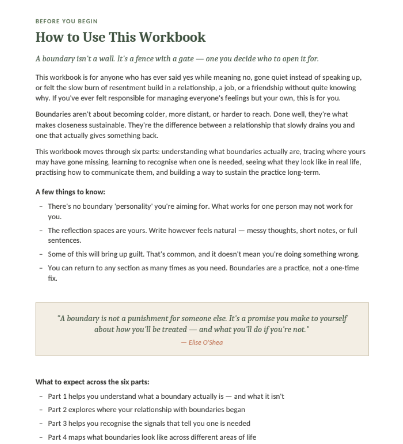 Image 2 of 3
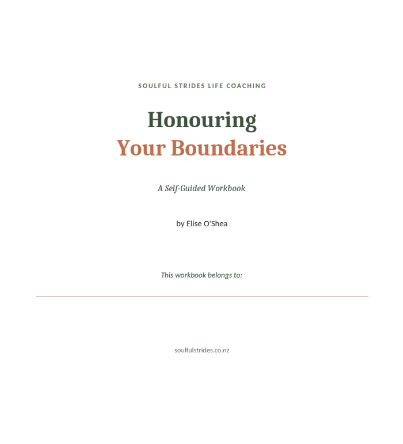 Image 3 of 3
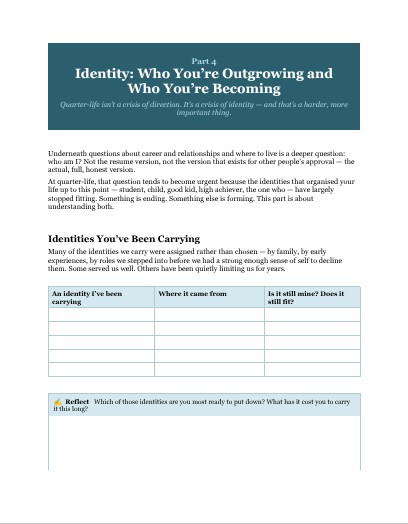
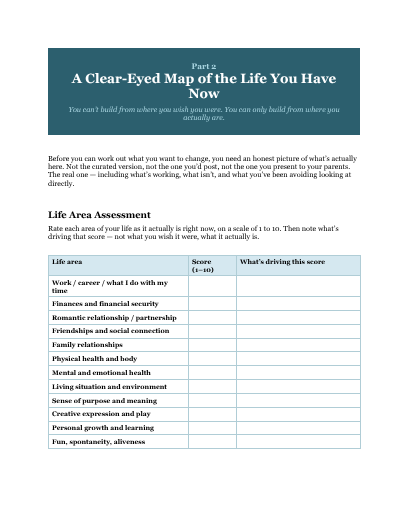
Honouring Your Boundaries is a self-guided workbook for anyone who has ever said yes while meaning no, gone quiet instead of speaking up, or felt the slow burn of resentment build in a relationship, a job, or a friendship without quite knowing why. Whether you're constantly overcommitted, unsure how to say no without over-explaining, or trying to understand why closeness so often feels draining instead of sustaining — this workbook gives you the structure to find out.
It's designed to be used as a companion for the situations you're navigating right now — the request you haven't answered yet, the relationship that's starting to feel one-sided, the conversation you've been avoiding. It will also ask you to think — not just to name the boundary, but to understand where your relationship with boundaries began, what silence has been protecting you from, and what you actually want your limits to make room for.
Inside you'll find a breakdown of the six types of boundaries (physical, emotional, mental, time, financial, and digital), a resentment audit to help you spot where one is already missing, a boundary-spectrum exercise to locate where you sit between porous and rigid, and a simple three-part formula for putting a boundary into words.
Part Five is where it all comes together: scripts for three different tones, a guide to handling pushback and guilt without abandoning the boundary, and a fill-in template for drafting the exact conversation you need to have. Part Six turns it into an ongoing practice, with a weekly check-in and a personal sustainability plan.
This workbook is for real relationships, not hypothetical ones. It's not a substitute for therapy if boundary violations have involved abuse or ongoing harm, but it will give you clearer language and a steadier foundation for the boundaries you're ready to hold.
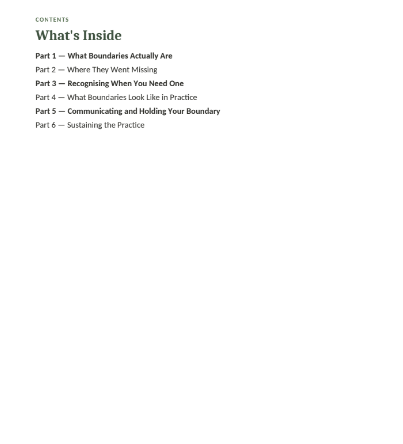
What's inside: Six parts covering the fundamentals of boundaries, where yours went missing, recognising when you need one, what they look like in practice, communicating and holding them, and sustaining an ongoing practice. 18 pages including reflection prompts, fill-in exercises, and a weekly check-in template.
Honouring Your Boundaries is a self-guided workbook for anyone who has ever said yes while meaning no, gone quiet instead of speaking up, or felt the slow burn of resentment build in a relationship, a job, or a friendship without quite knowing why. Whether you're constantly overcommitted, unsure how to say no without over-explaining, or trying to understand why closeness so often feels draining instead of sustaining — this workbook gives you the structure to find out.
It's designed to be used as a companion for the situations you're navigating right now — the request you haven't answered yet, the relationship that's starting to feel one-sided, the conversation you've been avoiding. It will also ask you to think — not just to name the boundary, but to understand where your relationship with boundaries began, what silence has been protecting you from, and what you actually want your limits to make room for.
Inside you'll find a breakdown of the six types of boundaries (physical, emotional, mental, time, financial, and digital), a resentment audit to help you spot where one is already missing, a boundary-spectrum exercise to locate where you sit between porous and rigid, and a simple three-part formula for putting a boundary into words.
Part Five is where it all comes together: scripts for three different tones, a guide to handling pushback and guilt without abandoning the boundary, and a fill-in template for drafting the exact conversation you need to have. Part Six turns it into an ongoing practice, with a weekly check-in and a personal sustainability plan.
This workbook is for real relationships, not hypothetical ones. It's not a substitute for therapy if boundary violations have involved abuse or ongoing harm, but it will give you clearer language and a steadier foundation for the boundaries you're ready to hold.
What's inside: Six parts covering the fundamentals of boundaries, where yours went missing, recognising when you need one, what they look like in practice, communicating and holding them, and sustaining an ongoing practice. 18 pages including reflection prompts, fill-in exercises, and a weekly check-in template.